AI naming benchmark · September 2026
9 Best AI Business Name Generators in 2026 — We Tested Them on the Same Brand Brief
AI can generate hundreds of business names in seconds.
That is no longer the difficult part.
The harder question is whether those names are actually distinctive, strategically relevant, memorable, and strong enough to become a real brand.
So we ran a simple experiment.
We gave the same naming brief to nine AI models and business-name generators: ChatGPT/OpenAI, Claude, Gemini, DeepSeek, Namelix, Shopify, Design.com, Jotform, and Preemp.
 Shopify
The challenge was deliberately specific: create 20 names for a premium organic baby hair shampoo designed for newborns aged 0–6 months.
Every system was asked to create names that felt premium, gentle, modern, emotionally warm, minimal, trustworthy, and internationally usable — while avoiding obvious naming shortcuts such as Baby, Pure, Organic, Gentle, and Soft.
Then we compared the outputs.
Not simply on which names sounded pretty.
We looked at originality, strategic fit, distinctiveness, premium feel, portfolio diversity, emotional relevance, and how much weak filler survived into the final shortlist.
Disclosure: Preemp is our own naming platform. This is not an independent ranking. We deliberately included weaknesses in Preemp's output alongside the strengths of competing systems. This is one benchmark conducted in September 2026, not a permanent judgment of any model or platform.
Quick answer: which AI business name generator was best?
There wasn't one system that dominated every dimension.
Claude produced some of the most immediately beautiful individual names.
ChatGPT/OpenAI came surprisingly close to specialist naming quality despite being a general-purpose AI.
Gemini generated polished premium names, but showed more stylistic repetition.
Namelix was especially good at making names feel real through immediate visual presentation.
Shopify and Design.com were better suited to fast brainstorming than deeper strategic naming in this particular test.
And Preemp produced the most deliberately varied strategic portfolio — although several names still deserved stronger editorial filtering before reaching a final client shortlist.
That distinction became one of the biggest lessons of the experiment:
AI is already very good at generating names. The next competitive advantage is judgment.
The brief we gave every AI naming tool
The product was a premium organic shampoo formulated specifically for newborn hair and scalp care.
The audience was primarily parents aged 25–44 in Canada and the United States who care about gentle, beautifully designed, trustworthy baby-care products.
The desired brand personality was:
gentle, pure, premium, calm, nurturing, minimal, modern, beautiful, trustworthy, delicate and emotionally warm.
The names should preferably be four to nine letters.
And we specifically asked the systems to avoid:
- clinical or pharmaceutical-sounding names
- childish baby-talk
- generic combinations using Baby, Pure, Natural, Organic, Gentle, or Soft
- medical or therapeutic implications
- names that sound like detergent or adult shampoo
No generated name was treated as trademark-cleared, domain-available, or legally safe simply because an AI generated it.
How the 9 AI name generators compared
| Tool | What stood out | Weakness in this test |
|---|---|---|
| Strategic range and deliberately different naming territories | Final editorial selection could still be more ruthless | |
| Excellent creative taste and premium language | Some concentration around luxury/European territory | |
| Strong raw creativity and brand-like inventions | Less systematic strategic exploration | |
| Beautiful, polished names | More repetition in naming style | |
| Elegant phonetics | Many outputs felt like personal names | |
| Attractive quick inspiration | Less strategic depth | |
| Excellent visual presentation | Heavy use of familiar category constructions | |
| Fast, accessible brainstorming | Predictable adjective+noun patterns | |
| Shopify | Extremely quick | Very literal and category-descriptive |
Claude: probably the strongest pure creative competitor
Claude produced names including:
Ondine, Elowen, Lullé, Plume, Alba, Nuvela, Velune, Olea, Suvi, and Serein.
What made the output strong wasn't simply that the names sounded attractive.
They represented different ideas.
Ondine brought mythology and water. Plume used tactility and lightness. Alba connected dawn with beginnings. Lullé translated the emotional world of newborn care into a compact invented form.
Claude also occasionally challenged its own suggestions rather than trying to sell every idea equally.
That matters.
A strong naming system should be able to say:
This sounds beautiful — but here is why it still might be wrong.
For pure creative taste, Claude was one of the strongest performers in the experiment.
ChatGPT/OpenAI: general-purpose AI is already very good at naming
The OpenAI baseline generated:
Avelou, Enfold, Ovelin, Plume, Lumae, Dovelle, Morrow, Nelumi, Looma, Hushen, and Elaro.
Several could comfortably appear in a professional naming presentation.
Enfold had a clear emotional idea. Morrow naturally connected with beginnings.
Names such as Avelou, Ovelin, and Nelumi showed that frontier general-purpose models are already capable of producing polished invented names.
This matters for anyone building an AI naming product.
Simply saying “Our AI generates good names” is no longer enough differentiation.
Preemp: strongest strategic portfolio — but not flawless
Preemp generated a deliberately varied portfolio including names such as:
Nuvami, Ovelle, Selumo, Hushloom, Embrin, Underwing, Morrow, Plume, Elaru, Everhum, Oravi, and Dewoven.
Rather than following one naming aesthetic, the engine explored coined names, compounds, blends, real words, symbolic directions, sensory territory, and emotional naming approaches.
One example was Hushloom.
The idea wasn't simply “something gentle.” It created a broader territory around quiet craftsmanship, while also warning against turning the idea of “hush” into an unsupported sleep or calming claim.
Embrin followed another route: embrace + beginning, giving the name an emotional story centered on the earliest parent-child bond instead of shampoo performance.
And Nuvami used a sound-led coined approach rather than relying on obvious baby-care language.
But Preemp wasn't flawless.
Names like Closeby, Dayheld, Belong, Inly, and Dewoven were strategically explainable, but not all felt equally strong enough for a top-tier client presentation.
That exposed an important distinction:
A name can be strategically defensible without being editorially exceptional.
Gemini: polished names with signs of AI naming convergence
Gemini produced:
Luma, Nuvia, Vella, Aven, Reverie, Elara, Dewen, Covea, Evora, Olea, and others.
The output looked sophisticated.
But across the portfolio, a repeated aesthetic began to appear: soft vowels, European-feeling endings, light, clouds, celestial imagery, nature, and botanical references.
Individually, several names were strong.
Collectively, they demonstrated something interesting:
AI models can converge on the same idea of what a “premium brand” should sound like.
And that may eventually become a branding problem of its own.
DeepSeek: attractive names, but many felt more like people than brands
DeepSeek produced names such as:
Liora, Aveline, Solenne, Caelin, Elowen, Maren, Aurelia, Amara, and Oona.
These are aesthetically pleasing.
But a significant portion feel like personal names.
There is nothing inherently wrong with using a personal-style name for a brand.
The issue was strategic diversity.
The portfolio felt closer to “Give me twenty beautiful names matching this mood” than “Give me twenty meaningfully different ways this brand could be named.”
Namelix: visual presentation changes how we judge names
Namelix's biggest strength became obvious immediately:
It showed names as brands.
Typography, colors, logo treatments, and visual identity made the suggestions feel tangible.
Examples included names such as Vessavia, Veridemia, Nuvanti, Orgalume, Originalis, alongside more descriptive constructions like BioBliss, PureBloom, Naturabloom, and Organica.
That visual experience is powerful.
But when the visual styling was mentally removed, several names relied heavily on familiar category vocabulary: Bio. Pure. Organic. Nature. Bloom.
This produced one of the more useful lessons from the test:
How a name is presented can dramatically influence how strong we think it is.
A good AI brand name generator should therefore help users imagine the brand — while ensuring the word itself remains strong enough to stand alone.
Jotform: attractive quick inspiration, lighter strategic depth
Jotform produced options including:
Lumina, Inari, Serra, Caelum, Mira, Calida, Nivali, Auri, Naya, Saiya, Olenna, Ylva, Eirene, Nivia, and Melo.
Several were attractive.
But again, many fell into existing-name or premium-phonetics territory.
For quick inspiration, that can work very well.
For a brand team trying to deliberately explore different naming strategies, the portfolio felt lighter than the strongest outputs.
Design.com: pleasant, accessible, and very predictable
Design.com generated names like:
Luna Bloom, Nurture Nest, Cuddle Cloud, Whisper Willow, Gentle Tide, Mellow Meadow, Calm Cove, Hush Haven, Velvet Leaf, and Silken Sky.
Another group included:
Lunara, Celesse, Sereva, Luxeva, Aureli, Soluna, Purae, and Cocoon.
The output is accessible and easy to understand.
Its weakness was predictability.
A significant portion followed either adjective + noun or soft premium invented word + familiar ending.
Useful for brainstorming. Less compelling as a differentiated naming strategy.
Shopify: quick business names, but solving a different problem
Shopify returned names such as Organic Infant Shine, Newborn Natural Wash, Infant Pure Essence, Babeeze, Babique, Nurtura, Organic Baby Dew, Gentle Baby Wash, Organiva, Tendera, Newbloom, Softiva, Infanique, and Pure Baby Bliss.
Many of those use the exact vocabulary our brief asked the systems to avoid: Baby. Pure. Organic. Gentle.
That doesn't mean Shopify's business name generator is bad.
It means it is optimized for a different job: help someone quickly generate understandable business-name ideas.
That's not necessarily the same as developing a differentiated premium brand asset.
The surprising pattern: AI naming is starting to converge
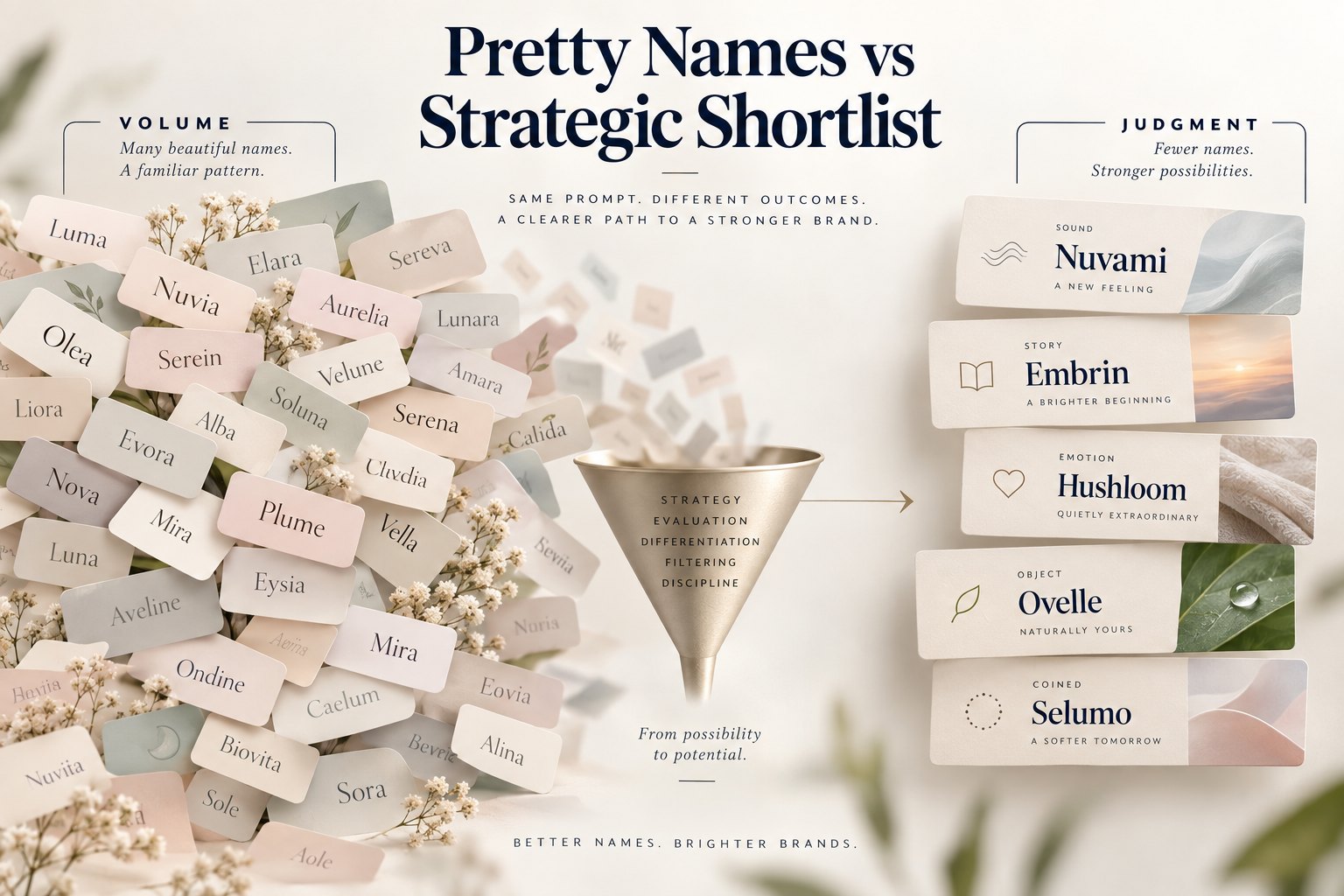
Across unrelated systems we repeatedly saw names and naming territories around:
Luma / Luna · Plume · Elowen · Wren · Serein · Aura · Nova · moon · cloud · light · soft botanical imagery
That may become one of the most important issues in AI-assisted naming.
Different systems are learning the same cultural patterns of what a premium modern brand “should” sound like.
So increasingly, the question won't be:
Can AI create something beautiful?
It will be:
Can AI create something that doesn't immediately sound like AI created it?
Generating names is becoming commoditized
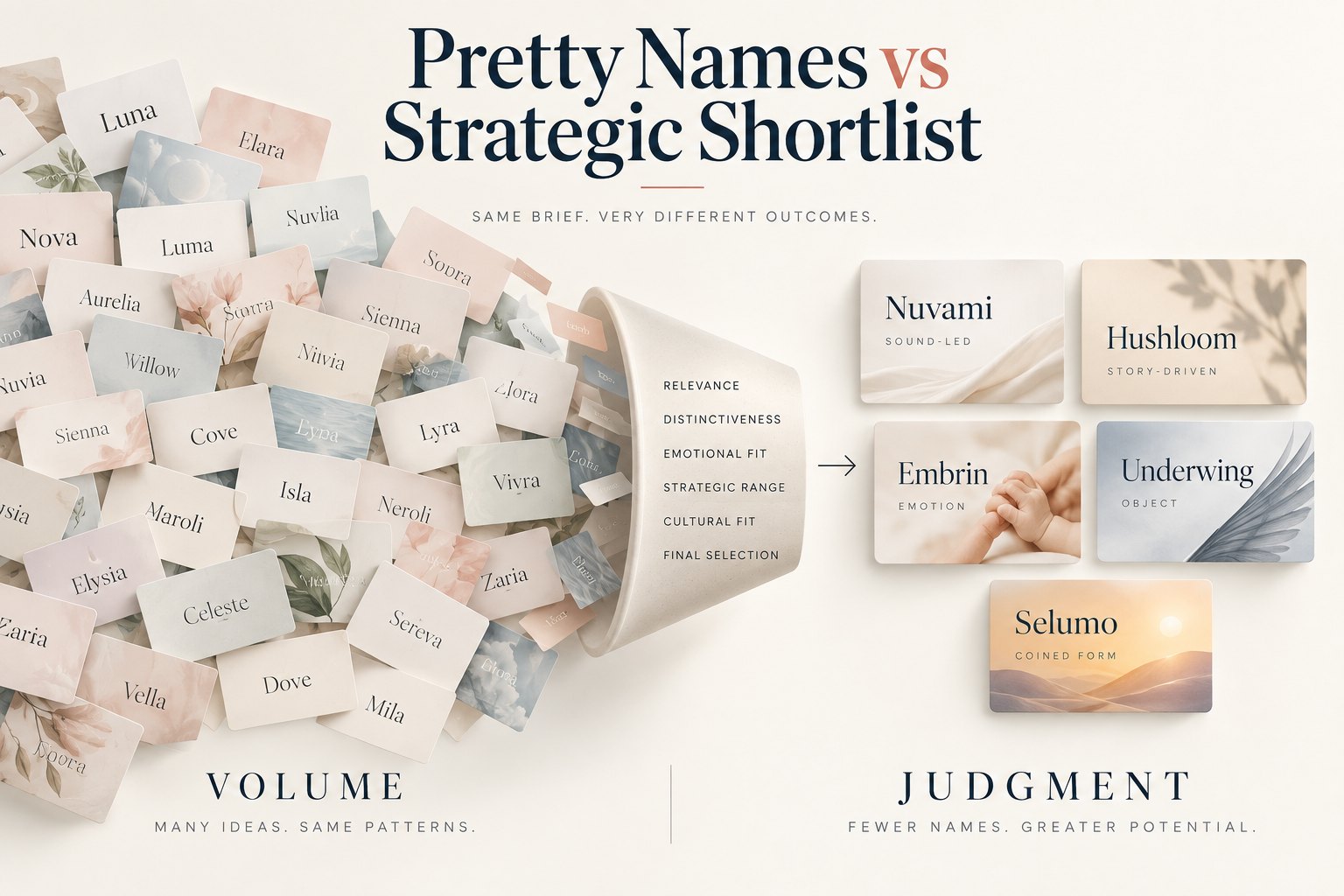
Historically, name generators competed on quantity.
20 names. 50 names. 100 names. Another 100.
But generative AI has effectively made quantity free.
The difficult work now happens after generation.
Which territories are worth exploring?
Which names are genuinely distinctive?
Which candidate sounds good only because the rationale is doing all the work?
Which ideas are really variations of the same naming trope?
Which attractive name hides a linguistic, cultural, or category problem?
And which names should never reach the client?
That is where the next generation of AI naming platforms will have to compete.
So which AI business name generator was best?
It depends on the job.
For pure creative taste: Claude was excellent.
For general-purpose AI naming: ChatGPT/OpenAI was remarkably competitive.
For polished premium inspiration: Gemini performed strongly.
For visual exploration: Namelix made generated names feel like brands very quickly.
For quick business-name brainstorming: Shopify and Design.com were accessible and fast.
For strategic naming diversity: Preemp was strongest in this particular experiment.
But no system produced twenty flawless names.
And that may be the most realistic result of all.
The future winner in AI naming probably won't be the tool capable of generating the most words.
It will be the one that knows:
- what to explore,
- what to reject,
- what to question,
- what to validate,
- and what deserves to survive into the shortlist.
AI naming FAQ
What is the best AI business name generator in 2026?
There is no universal winner. In our same-brief test, Claude performed particularly well on raw creative naming, ChatGPT/OpenAI was highly competitive as a general-purpose AI, Namelix stood out for visual ideation, and Preemp performed particularly well on strategic naming diversity.
Can ChatGPT generate good business names?
Yes. Our test showed that ChatGPT/OpenAI can generate polished invented names, emotional real-word names, and credible brand concepts. The harder challenge is consistently evaluating and narrowing those ideas.
Are AI-generated business names trademark-safe?
No. A generated name should not be assumed to be trademark-safe, legally available, or commercially usable simply because an AI suggested it. Trademark clearance, domain availability, social handles, and linguistic screening are separate steps.
What makes a good AI brand name generator?
A strong AI naming tool should understand the brand strategy, explore different naming methods, identify weak or repetitive ideas, explain why candidates fit, flag relevant risks, and help users move toward a usable shortlist.
Is Namelix better than Shopify's business name generator?
They serve different needs. Namelix emphasizes brandable naming ideas and visual presentation, while Shopify is useful for quickly generating understandable ecommerce and business-name ideas.
Should I use AI or a naming agency to name my company?
AI can dramatically accelerate exploration. Human naming experts remain valuable for high-stakes strategy, nuance, stakeholder alignment, legal coordination, and final editorial judgment. The strongest workflows increasingly combine AI-scale exploration with disciplined human decision-making.
Conclusion
AI has already changed brand naming.
The question is no longer whether a machine can invent a clever word.
It can.
The harder question is whether an AI naming tool can understand strategy, resist obvious conventions, explore genuinely different territories, challenge weak ideas, identify risk, and help people make a confident decision.
That is a much higher bar than generating twenty names.
And based on this experiment, that is where the future of AI-powered brand naming gets interesting.
Related Articles
Comparison
Preemp vs Namelix: Which Brand Name Generator Should You Choose?
A focused comparison of two different approaches to AI naming.
Read moreProcess
The Brand Naming Process: 7 Steps From Brief to Registered Name
The complete naming sequence, from strategy to registration.
Read moreMethods
Brand Naming Methods Explained: 21 Types With Examples
The strategic methods behind more varied, defensible names.
Read more